Quick answer
- Where to stay: in the south, Amadores and Puerto Rico for the calmest water, or Maspalomas and Meloneras for flat streets and the most family resorts. In Las Palmas, near Las Canteras if you prefer a city base without a car.
- Getting around: without a car, buses and taxis cover the south coast and the capital well; for theme parks and the interior, hire a car and book the child seats with it.
- Child seats: required below 135 cm, including in the taxi from the airport, because it runs on the motorway.
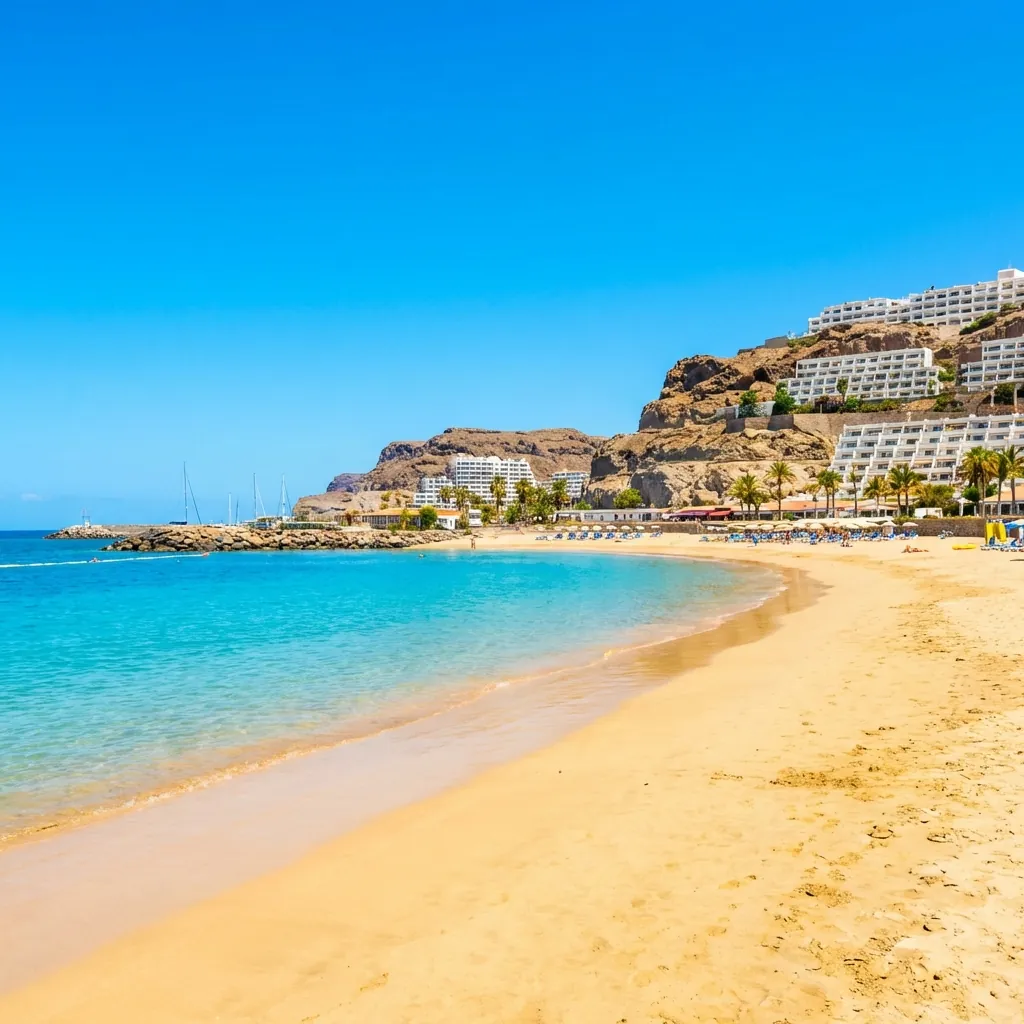
- Calmest beaches: Amadores, Puerto Rico and Puerto de Mogán, sheltered by breakwaters, and the northern stretch of Las Canteras.
- When to go: any month works. Average highs run from 20.8 °C in January to 27.5 °C in August; Easter, summer and Christmas book up first.
- What to do: attractions, compared by age and budget, are in our guide to the best family attractions.
Where to stay with kids: the area matters more than the hotel
Gran Canaria is small, but each area changes your days: the type of beach, the climb back to your room and the transfer from the airport. With young children, choose the area first and the hotel second.
Amadores and Puerto Rico
For babies and children who cannot swim well yet
Two bays enclosed by breakwaters, with very little swell, lifeguards and facilities. A flat seafront promenade links them and works with a pushchair, and boat trips leave from Puerto Rico harbour.
Watch out: many Puerto Rico apartments sit on steep hillsides. Check the real climb to the beach.
Maspalomas, Meloneras and Playa del Inglés
For families who want variety without a car
The widest choice of resorts with pools, flatter streets and a promenade to the dunes and the lighthouse. Aqualand and Palmitos Park are a short drive away. San Agustín, linked by the promenade, is the quiet version.
Watch out: the beach is open and gets more swell than the south-west bays. Always check the flag.
Puerto de Mogán
For a quiet stay with young children
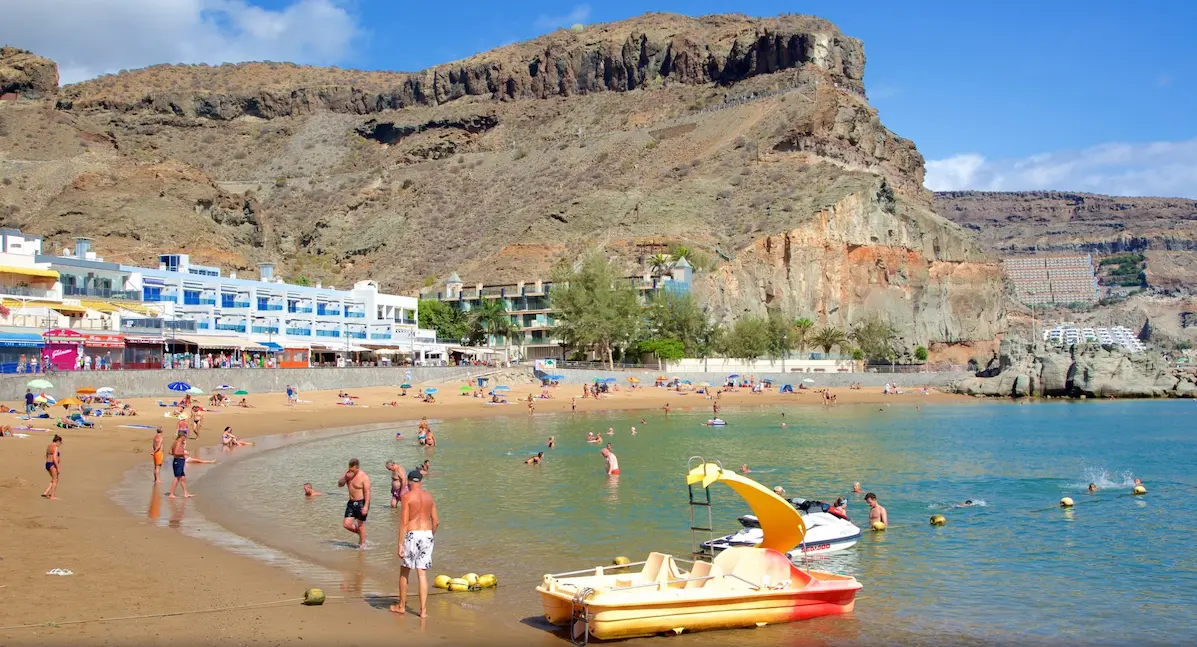
A village of canals with a small, sheltered beach, a gentle entry, showers, toilets and a lifeguard. Everything is walkable and evenings are quieter than in the big resorts.
Watch out: it is the furthest area from the airport, the beach fills early and the Friday market brings more traffic.
Las Palmas de Gran Canaria
For families who prefer a city and no car
The northern stretch of Las Canteras, sheltered by La Barra reef, has calm water right off the promenade. Poema del Mar and the Museo Elder are close by, and city buses cover the whole city.
Watch out: in winter the sunshine is more reliable in the south, and at Las Canteras the tide changes the beach a lot.

Before you book, ask about
- The real distance and gradient to the beach, not just the minutes on the map.
- Cots and high chairs: included or charged extra.
- Whether the children’s pool is heated: the sea is around 18 °C in winter.
- A kitchen and washing machine: with kids they save meals and luggage.
- Parking, if you are hiring a car.
Every area, including the less touristy ones, in our guide to where to stay in Gran Canaria.
Getting around with kids: car, taxi or bus
For a beach stay in the south or in Las Palmas you do not need a car. For theme parks, inland villages and quieter beaches it saves a lot of time, especially around naps and changes of plan.
From the airport to your accommodation
| Destination | Global bus | Taxi (approx.) |
|---|---|---|
| Las Palmas (San Telmo / Santa Catalina) | Route 60: €2.30 / €2.95 | €30–45 |
| Playa del Inglés | Routes 66 and 90: €3.50 | €35–50 |
| Maspalomas lighthouse | Route 66: €4.05 | €40–55 |
| Puerto Rico | Route 91: €5.45 | €55–75 |
| Puerto de Mogán | Route 1: €6.80 | €65–90 |
Fares published by Global and Aena, checked on 2 August 2026 for our airport transfer guide. With three or four people and luggage, compare the total bus fares with a taxi or private transfer. Stops, timetables and the last bus on each line: bus guide from the airport.
Child car seats: the rules
In Spain, children under 135 cm must travel in an approved child restraint suited to their height and weight, as a rule in the back seats. From 135 cm they may use the adult seat belt, although the DGT, Spain’s traffic authority, recommends a booster up to 150 cm.
Taxis have one nuance: a child seat is not required on urban journeys, but it is on motorways and dual carriageways, and the run from the airport uses the GC-1 motorway. Ask for one when you book the taxi or transfer. For a hire car, book the seat with the vehicle: some local companies include it, others charge per day.
Buses and pushchairs
On the Las Palmas city buses (Guaguas Municipales), children under 4 travel free without taking a seat; from 4 they need a ticket. An unfolded pushchair is allowed when the wheelchair space is free, with the child strapped in, facing backwards and the brake on. On Global’s intercity buses, check the child fare before you travel. Routes and cards are in our bus guide.
Hire car
A car pays off if you plan to combine theme parks, distant beaches and a trip up to the summits. Inland roads are very winding: if anyone gets car-sick, plan stops. At Amadores the car park fills at weekends, so arrive before midday. Insurance and how to avoid overpaying are in our car hire guide.
Beaches for kids
In the south-west, several beaches are man-made bays protected by breakwaters: the water shelves gently and there are hardly any waves. In the capital, La Barra reef does the same for the northern half of Las Canteras. Even so, none of them is immune to changes in wind or sea.
| Beach | Why it works with kids | Bear in mind |
|---|---|---|
| Amadores | About 500 m of pale sand between two breakwaters, with lifeguards, toilets and showers. | It gets busy; at weekends, park before midday. |
| Puerto Rico | A bay closed off by breakwaters, with the promenade and facilities right behind. | Very crowded in high season. |
| Puerto de Mogán | Small and sheltered, with a gentle entry, showers, toilets and a lifeguard. | Little space: arrive early. |
| Las Canteras (northern stretch) | La Barra breaks the swell between Playa Grande and La Puntilla; gently sloping sand and lifeguards. | The tide changes the beach a lot; at the southern end, La Cícer, there are surfing waves. |
| Las Marañuelas (Arguineguín) | Calm water sheltered by the harbour, with a local feel. | Dark volcanic sand. |
In the water
- Green flag, swimming allowed; yellow, take care; red, no swimming.
- Lifeguards work set hours and seasons: check at the beach itself.
- In an offshore wind, inflatables drift out fast even when the sea looks calm.
- Water shoes for rocky areas and for the pools La Barra leaves at low tide.
Every beach, compared by the kind of day you want, in our Gran Canaria beaches guide.
When to go with kids
The weather allows any month; what changes is the sea temperature, demand and wind.
Winter (Dec–Feb)
Highs 20.8–22.2 °C · lows 15.0–16.2 °C
The sea is around 18 °C, so a heated pool helps. Christmas is high season.
Spring (Mar–May)
Highs 22.3–23.6 °C · lows 15.7–17.3 °C
A good time to mix beach days and trips. Book Easter early.
Summer (Jun–Aug)
Highs 25.3–27.5 °C · lows 19.2–21.6 °C
The sea is near 22 °C. School holidays mean more demand: book early.
Autumn (Sep–Nov)
Highs 24.2–27.2 °C · lows 18.1–21.4 °C
Gentle heat and less pressure outside the school holidays.
Temperatures: AEMET climate normals for Gran Canaria Airport (1981–2010). Sea: guidance from the Gran Canaria tourist board.
When the trade winds bring cloud to the north and Las Palmas, the south usually stays clearer, and the summits are much cooler than the coast. Month by month: best time to visit Gran Canaria.
Health and safety
- Emergencies: 112. Free to call, and answered in Spanish, English, German, Italian and French.
- Children’s A&E: the main public hospital for children is the Hospital Universitario Materno-Infantil de Canarias, on Avenida Marítima del Sur in Las Palmas de Gran Canaria. In the south there are public health centres and private clinics; if you have travel insurance, ask which ones it works with.
- Health cards: from the EU, bring each child’s EHIC; UK residents can use a GHIC. Both cover state healthcare, not private clinics.
- Duty pharmacies: they rotate; the current list is posted on the door of any pharmacy.
- Sun: it burns even in winter and under cloud. High-factor sun cream, a hat and a UV top for the water, and shade in the middle of the day.
- Calima: when Saharan dust arrives, air quality drops. With asthmatic children, cut back outdoor activity and follow official alerts.
- Maspalomas dunes: the sand burns at midday and distances are deceptive. Go early or late in the afternoon and stay on the marked routes.
An unhurried week with kids
The rule that works best: one main outing a day, grouped by area, and at least one free day. Based in the south, it looks like this:
- Day 1 · Arrival. Pool or beach next to your accommodation, plus a supermarket run.
- Day 2 · Maspalomas dunes and lighthouse first thing, beach afterwards. How to visit them.
- Day 3 · Theme-park day: Palmitos Park or Aqualand, depending on ages. Which to choose.
- Day 4 · Amadores and the walk to Puerto Rico; a boat trip if the sea allows. Whale and dolphin watching.
- Day 5 · Las Palmas: Poema del Mar and Las Canteras, just under an hour from Maspalomas on the GC-1.
- Day 6 · Puerto de Mogán (market on Fridays) or, if the kids walk well, Roque Nublo with warm layers.
- Day 7 · Free to repeat the favourite beach or catch up on a plan the weather moved.
Based in Las Palmas? Reverse it: city and Las Canteras first, then two days in the south. More ideas in the 7-day itinerary.


What to do with kids by age
This guide is about organising the trip. To choose attractions, with prices, height limits and which one is worth it on the day, use our comparison. A starting point by age:
Ages 0–3
Beaches inside breakwaters, flat seafront promenades and an indoor aquarium such as Poema del Mar.
Ages 4–8
Poema del Mar, Palmitos Park and an active play park such as the Angry Birds Activity Park in Puerto Rico.
Ages 9–12
Aqualand, a boat trip to see whales and dolphins, and the Museo Elder for a windy day.
Ages 13–17
The big slides at Aqualand, snorkelling at Las Canteras and the climb to Roque Nublo.
See the 8 best family attractions
What to pack
For the beach
- High-factor sun cream, a hat and a UV top for the water.
- Water shoes for the rocks.
- Your own shade: not every beach rents parasols.
- Plenty of water, especially for the dunes.
For the rest of the trip
- A warm layer for the summits and winter evenings.
- A light, folding pushchair: there are slopes and steps.
- Each child’s health card.
- Regular medication and a basic first-aid kit.
Frequently asked questions
Is Gran Canaria a good destination for kids?
Yes. It has mild weather all year, calm-water beaches sheltered by breakwaters and short journeys between the resorts. The key is choosing the right area: it decides the type of beach, the hills and how much you will travel each day.
What is the best area to stay with young children?
Amadores and Puerto Rico, for their sheltered bays, or Maspalomas and Meloneras if you prefer flat streets and more family resorts. In Las Palmas, the Las Canteras area works if you want a city base without a car.
Do you need a hire car for a family holiday?
Not for a beach stay in the south or in Las Palmas: buses and taxis cover those areas well. It pays off if you want to visit theme parks, inland villages or remote beaches. Book the child seats with the car.
Is a child seat required in a taxi from the airport?
Yes, for children under 135 cm. The rules exempt taxis on urban journeys, but not on motorways and dual carriageways, and the airport run uses the GC-1. Ask for a seat when you book the taxi or transfer.
Do children pay on the bus?
On the Las Palmas city buses, children under 4 travel free without taking a seat; from 4 they need a ticket. On Global’s intercity buses, check the child fare before you travel.
When is the best time to visit Gran Canaria with kids?
Any month works: average highs run from 20.8 °C in January to 27.5 °C in August. Easter, summer and Christmas are the busiest dates; in winter the sea is around 18 °C, so a heated pool helps.
What can you do with kids when the weather is bad?
Poema del Mar and the Museo Elder in Las Palmas are the easiest indoor plans. When the north is cloudy the south can still be clear, so switching coasts is often enough.
Sources and method
Reviewed 23 September 2026. This guide covers the logistics of a family trip; attractions have their own comparison. Child-seat rules come from the DGT, Spain’s traffic authority; city-bus and pushchair rules from Guaguas Municipales; airport fares from Global and Aena (checked 2 August 2026); climate data from AEMET. Prices, timetables and rules change: confirm them before you set off.
- DGT: travelling with children (Spanish)
- DGT: child seats from A to Z, taxis and height (Spanish)
- Guaguas Municipales: rules of use (Spanish)
- Aena: buses at Gran Canaria Airport
- AEMET: climate normals for Gran Canaria Airport (Spanish)
- 112 Canarias: help in five languages (Spanish)
- Canary Islands Health Service: Insular-Materno Infantil hospital complex (Spanish)

By Enrique Medina · Reviewed 23 September 2026
Local author from Las Palmas de Gran Canaria. This guide brings together what makes or breaks a family holiday (area, transport, beaches and health) from official sources and our guides to each place.