Hike profile
Short · uphill · uneven groundPlan your approach
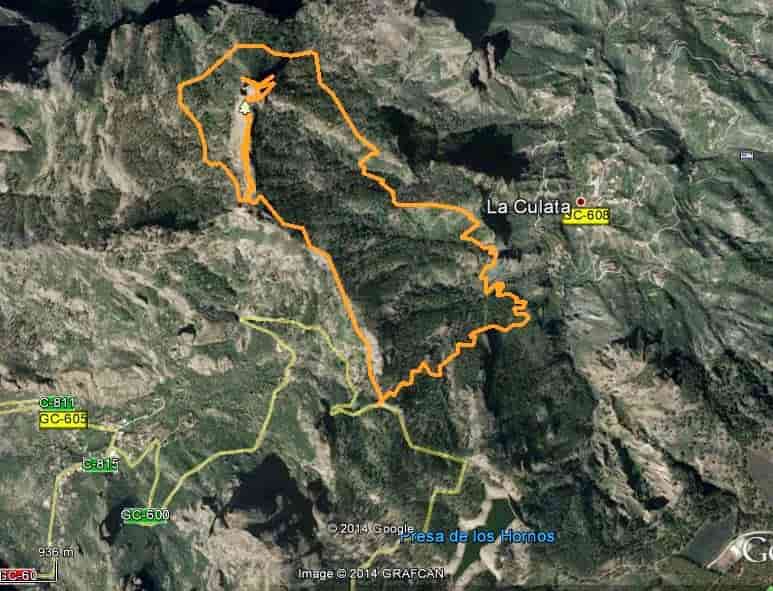
Route and access map
This shows the short walk from the Degollada de La Goleta bus stop, where cars can no longer park. It is not a navigation track; follow the signs on the day.
See the landscape
What the walk looks like
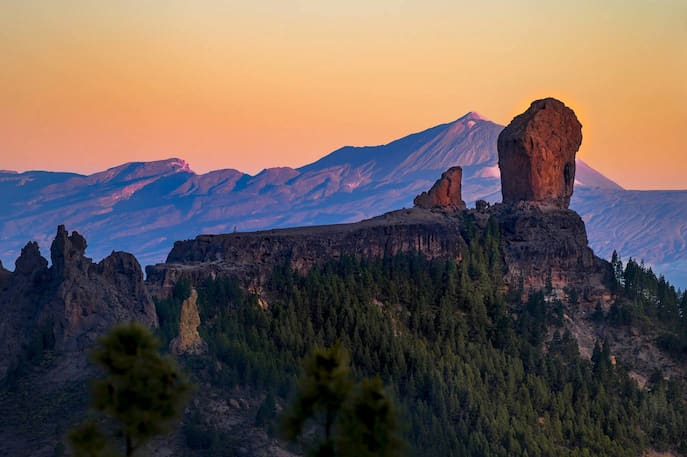
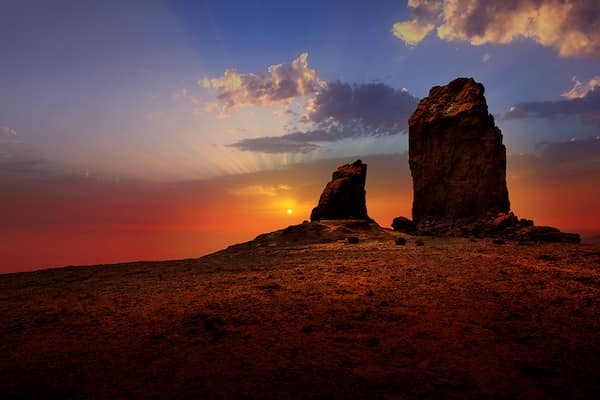
Roque Nublo is one of those places that makes the scale of Gran Canaria suddenly clear. From the coast, the island can look like a beach destination; from this trail, it reveals ravines, pine forests and ancient volcanic walls. The dark monolith stands on a high plateau near Tejeda and has long been a landmark for islanders. It is also a protected natural place, so a good visit is as much about planning and restraint as it is about reaching the viewpoint.
Why Roque Nublo deserves a place in your itinerary
The rock itself is dramatic, but the setting is what makes the walk memorable. On a clear day, the route opens towards the central caldera, the pine-covered ridges around Artenara and Tejeda, and the distant summit of Pico de las Nieves. Looking west, you may also see the ocean and, when conditions allow, Tenerife's Teide on the horizon. The changing light is part of the appeal: morning can be fresh and crisp, while late afternoon brings warm colour to the surrounding cliffs.
Roque Nublo also carries cultural weight. It was important to the island's pre-Hispanic inhabitants and remains a powerful symbol of Gran Canaria. Treat it as more than a photo stop. Stay on the marked path, keep noise low near other walkers and never carve the rock; climbing it needs a permit from the Cabildo. The smallest choices help protect a place that receives many visitors.
The classic La Goleta route
The usual route, trail S-70, begins at Degollada de La Goleta, where the line 18 shuttle bus stops; private cars can no longer park there. It is the most practical option for first-time visitors because the path is clear, relatively short and gives a satisfying approach to the monolith. The surface is uneven in places, with stones, loose grit and a steady rise rather than a long, technical climb. Do not underestimate it simply because it is short: the altitude, sun and wind can make it feel more demanding than a promenade walk.
Walk at a pace that lets you look around. The trail passes Canary Island pine and low mountain vegetation before reaching an open area where Roque Nublo appears close at hand. The final section is the busiest, especially around the main photo viewpoints. Give people space, do not step onto fragile vegetation for a picture, and keep well away from exposed edges. In cloud, the rock can appear and disappear in minutes; that atmosphere is beautiful, but it is a reason to stay together and follow the obvious path carefully.
For a simple outing, return the same way. More experienced hikers can connect the visit with longer routes in the central mountains, but those plans need a map, daylight margin and a realistic assessment of weather. Mobile signal is not something to depend on in every fold of the landscape. Download maps and save essential information before leaving your accommodation.
Getting there: booking, parking and the shuttle bus
Since 2025 the Cabildo de Gran Canaria has managed access to the Natural Monument in three ways: a booking at the busiest hours, no private cars at the trailhead and a shuttle bus from two park-and-ride car parks. This is how it works, checked on 23 September 2026.
1. Book a slot (10:00–17:00)
Between 10:00 and 17:00, every day, you need a free booking to enter the trail. Slots last an hour and hold 60 people; one booking covers up to 5 people and asks for an ID card or passport number. After booking you get an email with a link: confirm it and the ticket arrives with a QR code. Before 10:00 and from 17:00 no booking is needed. Bookings are suspended during a forest-fire alert.
Book at reservasroquenublo.com
2. Park at Cruz de Los Llanos or Tejeda
The car park at Degollada de La Goleta, at the foot of the trail, has been closed to private cars since 2 January 2025 and is now a bus stop. Leave the car at one of the two park-and-ride car parks: Cruz de Los Llanos, the closest, or Tejeda village. From Las Palmas you drive up the GC-15 through Santa Brígida and San Mateo; from the south, the GC-60 through Fataga, San Bartolomé de Tirajana and Ayacata. Both are winding mountain roads, so allow more time than a map app suggests.
3. Ride the line 18 shuttle bus
Global's line 18 runs the loop Tejeda – Cruz de Tejeda – Cruz de Los Llanos – Roque Nublo – Ayacata in both directions and stops at Degollada de La Goleta, where the trail starts. It calls there about twice an hour between 09:30 and 18:30: roughly 9 minutes from Cruz de Los Llanos and 30 from Tejeda. You pay Global's normal fare and travel passes are valid. Three buses a day run direct from Faro de Maspalomas in the south; a single from there costs €6.00 (fares and other day trips by bus).
Line 18 times at Roque Nublo
| From | To Roque Nublo | Back |
|---|---|---|
| Cruz de Los Llanos car park | Leaves at 09:51, 10:51, 11:51, 13:21, 14:21, 15:51, 16:51 and 17:51; arrives 9 minutes later. | Calls at Roque Nublo at 09:30, 10:30, 11:30, 13:00, 14:00, 15:30, 16:30, 17:30 and 18:30; arrives 5 or 6 minutes later. |
| Tejeda (village) | Leaves at 09:30, 10:30, 11:00, 11:30, 12:30, 13:00, 13:30, 14:00, 15:00, 15:30, 16:30, 17:00, 17:30 and 18:00; takes about 30 minutes. | Every bus calling at Roque Nublo returns to Tejeda except the 11:00, 13:30 and 18:00, which continue to Maspalomas. |
| Faro de Maspalomas | Leaves at 08:00, 09:00 and 15:00; arrives at 09:30, 10:30 and 16:30. | Calls at Roque Nublo at 11:00, 13:30 and 18:00. |
Official timetable from the Cabildo, TGC and Global, the same on working days and public holidays. Check the current PDF before you go.
Sunrise and sunset
Sunrise (between about 07:00 and 08:10, depending on the season) and sunset (between 18:05 and 21:05) fall outside the booking hours, so no booking is needed. There is no bus either: the first one reaches the trailhead at 09:30 and the last leaves at 18:30, and you still cannot park at La Goleta. You walk in or out on the summit trails. According to the Cabildo, the waymarked S-50, S-51 and S-51.1 trails link the Llanos de la Pez recreation area with Degollada de La Goleta in 35 to 90 minutes, depending on the variant. Take a head torch, a warm layer and the route saved offline.
Rules of the Natural Monument
- Compulsory kit: suitable footwear, a warm layer, drinking water and a charged mobile phone. Cabildo staff can ask to see it and send you out of the area if you do not have it.
- Walk only on the marked trails; leaving them is prohibited.
- Dogs must be under control on a non-extendable lead.
- No drones for recreational, tourist or commercial use, no camping, no fires and no amplified music.
- No entry during a forest-fire alert or maximum alert.
- Keep away from cliff edges and take care at the foot of the monolith: there may be climbers and falling rocks.
Full rules from the Cabildo (Spanish)
Sources, checked on 23 September 2026: the Cabildo's booking system (slots and access conditions), the official line 18 timetable (PDF from the Cabildo, TGC and Global) and eldiario.es (26 December 2024: closure of the La Goleta car park and alternative trails).
Best time, weather and what to wear
October to May often offers comfortable walking temperatures, although every month can bring a different mountain forecast from the coast. Winter mornings may be cold, and cloud or rain can arrive quickly. Summer is perfectly possible if you begin early, but midday heat and strong sun are reasons to shorten ambitions. The inland forecast—not the beach forecast—is the one that matters here.
Wear shoes with a grippy sole, even if you do not own full hiking boots. Take at least one extra layer, sunscreen, a hat, water and a snack. Wind can be surprisingly sharp at the plateau, and smooth-looking stone becomes slippery after rain. In fog, strong wind or storms, choose another day. The reward at Roque Nublo is the panorama, and waiting for safer, clearer conditions is usually the better experience.
Make a full day of the central island
Roque Nublo works especially well as the centrepiece of an inland day. Pair it with Tejeda for a coffee or a meal, stop at viewpoints on the mountain roads, and leave enough time to travel slowly. If you have another day, explore the island's coastal contrasts at the Maspalomas Dunes or head north-west to Agaete and Puerto de las Nieves. Those combinations show why Gran Canaria is often called a miniature continent.
Do not try to squeeze every inland attraction into the same afternoon. Mountain driving takes concentration, viewpoints invite unplanned stops and the best photos rarely happen on a rigid timetable. A slower plan—one walk, one village and one scenic drive—is more enjoyable and leaves room to adapt if cloud covers the summit.
Hike responsibly
Take all rubbish home, including fruit peel and tissues. Flying drones for recreational, tourist or commercial use is banned in the Natural Monument. Keep dogs on a non-extendable lead, and never light a fire or discard cigarettes in the mountains. Gran Canaria's pine landscapes are resilient but vulnerable to fire and erosion. Staying on the established path protects plant life and helps the next visitor find the same sense of open space.
Finally, remember that a great visit does not depend on standing at the exact centre of every photo. Give other people time at the viewpoints, enjoy the walk back and let the landscape be the main event. That is the most reliable way to leave with both good pictures and a good memory.
A simple plan for a first visit
For most visitors, the best approach is uncomplicated: book a morning slot, leave the coast early, park at Cruz de Los Llanos and take the line 18 bus to La Goleta, walk up at an unhurried pace, then continue to Tejeda for lunch or coffee. This leaves a useful buffer for traffic, cloud or a queue at a viewpoint. It also means that the mountain is not competing with a long list of other stops. If the weather closes in, enjoy the drive and village instead, then return on a clearer day. Roque Nublo is impressive because of the landscape around it; visibility matters more than ticking the name off a list.
Photographers should bring a fully charged phone or camera, but avoid carrying a heavy bag simply for a short route. A light waterproof layer, water and a snack are more valuable. Families can turn the walk into a small nature challenge by looking for pine cones, changing rock colours and the outline of the neighbouring peaks. Couples and independent travellers often enjoy the same route most when they linger after the main crowds have moved on. Whatever your style of travel, leave a margin of time for the descent and drive back.
A relaxed mountain day
A simple visit timeline
- 1. BookReserve a free slot for 10:00–17:00 and check the inland forecast.
- 2. ParkLeave the car at Cruz de Los Llanos or Tejeda and take the line 18 bus.
- 3. WalkTake the La Goleta route slowly, pausing for the changing views.
- 4. ContinueReturn in daylight, then enjoy Tejeda or a mountain viewpoint.
Roque Nublo FAQ
How difficult is the route?
It is a short, moderate mountain walk rather than a technical hike. Most reasonably active visitors manage it comfortably when they wear suitable shoes, carry water and allow time for the uphill sections.
Is the route suitable if I only have trainers?
Good trainers with traction can work in dry weather, but avoid smooth-soled casual shoes. Choose hiking footwear if rain is likely, you have less confidence on uneven ground or you plan a longer route.
Can I visit at sunset?
Yes. No booking is needed after 17:00, but the last shuttle bus leaves the trailhead at 18:30 and you cannot park at La Goleta, so after sunset you walk back to your car on the summit trails. Take a head torch and a warm layer, and do not let a sunset photograph pressure you into descending in poor light.
Are there toilets or shops on the trail?
Facilities near mountain access points can be limited or change with management arrangements. Bring what you need, including water, and use services in nearby villages before beginning the walk.
What should I check on the morning of my visit?
Check the inland weather forecast, your booking (for 10:00–17:00), whether a forest-fire alert is in force, and the bus times back to your car. Those four checks prevent most avoidable problems.