Caldera de Bandama: how to visit Gran Canaria's volcanic crater
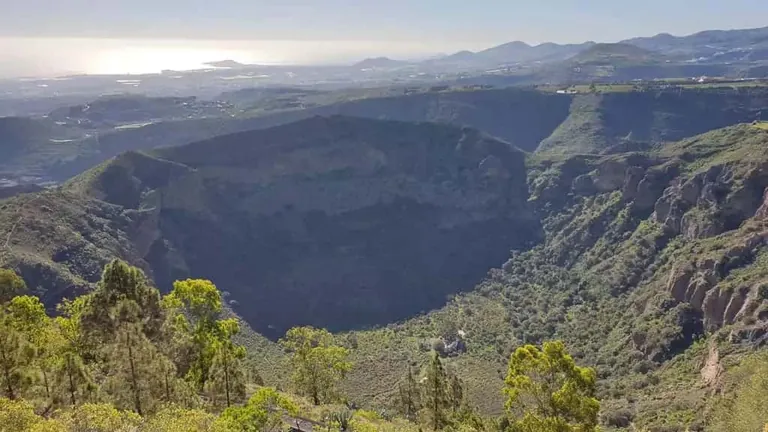
A bowl a kilometre wide and 200 metres deep, 20 minutes from Las Palmas by car and 22 by bus. Look at it from the rim in half an hour, walk right round it in an hour and a quarter, or go down to the floor, where a farm and a set of Guanche caves are still there.
What Bandama is, and whether it is worth the trip
Bandama sits above Tafira, between Las Palmas and Santa Brígida. The crater is about 1,000 metres across and 200 metres deep, the cone beside it — Pico de Bandama — reaches 569 metres, and the whole thing formed roughly 4,000 to 5,000 years ago.
It is not a caldera in the strict sense but a maar: a crater blasted open when rising magma met groundwater and flashed it to steam, rather than one left when a volcano collapses into its own emptied chamber. The island calls it the Caldera de Bandama anyway, and so does this page.
Go if you want a landscape on this scale without driving into the mountains. From the viewpoint you look 200 metres straight down onto cultivated plots and a farmhouse, and out over Las Palmas, the airport bay and — when the air is clear — Fuerteventura. It costs nothing and half a day covers it.
Skip it in low cloud or heavy calima haze, both common at this altitude: the whole point is the view. If the rim is capped, spend the morning in Vegueta instead.
Getting there from Las Palmas
By bus
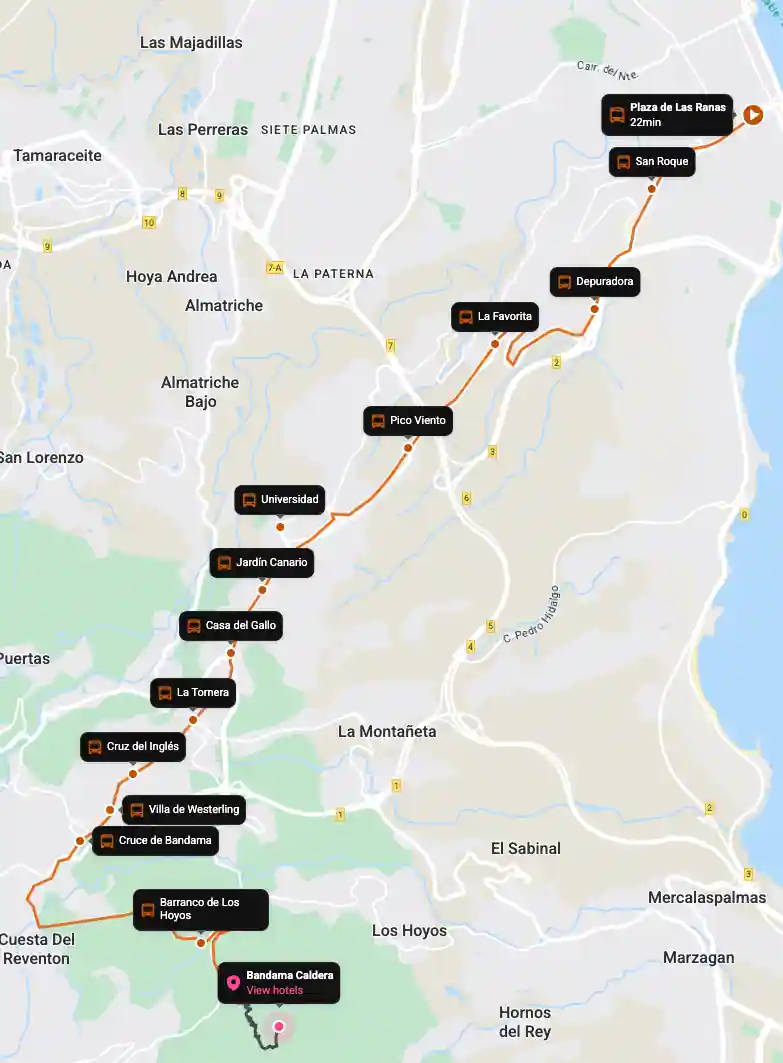
Global line 311 (Las Palmas – Santa Brígida) leaves San Telmo, Platform 4. The ride is about 22 minutes, a single costs around €1.55, and departures are roughly hourly. Get off at the Bandama stop beside the golf club; the Pico viewpoint is further up a side road with no pavement in parts, so check the walk on a map first. From the south, take line 1 or 5 to San Telmo and change — the island bus guide covers fares and how to pay.
By car
About 14 km and 20 minutes from Las Palmas on the GC-802 through Tafira, then the signed viewpoint road; roughly 45 minutes from Playa del Inglés on the GC-1 and GC-4. There is a free car park at the top of the viewpoint road and a second area near the visitor centre, both filling at weekends and near sunset. See the car rental guide.
By taxi
About 20 minutes from the city centre for roughly €25–30 each way: worth it for three or four in a hurry, hard to justify otherwise.
What there is to do: rim, crater floor and caves
Three visits, very different in length. Pick one before you arrive — the walk down is not something to start on impulse.
The viewpoint only
30–45 min · paved · easy
Park at the top and walk the last few metres to the platform on a short surfaced path — fine with a pushchair or limited mobility.
The rim circuit
3.4 km · about 1h 15 · moderate
A loop round the lip on volcanic gravel that rolls underfoot. No shade, no water, and some stretches run close to an unrailed edge. More routes in the hiking guide.
Down to the floor
2–3 h return · steep · demanding
The descent starts on the Bandama village side, not at the viewpoint, dropping 200 metres on loose picón: easy down, hard back up in the heat. At the bottom, the plots, the farmstead and the caves.
The Guanche caves
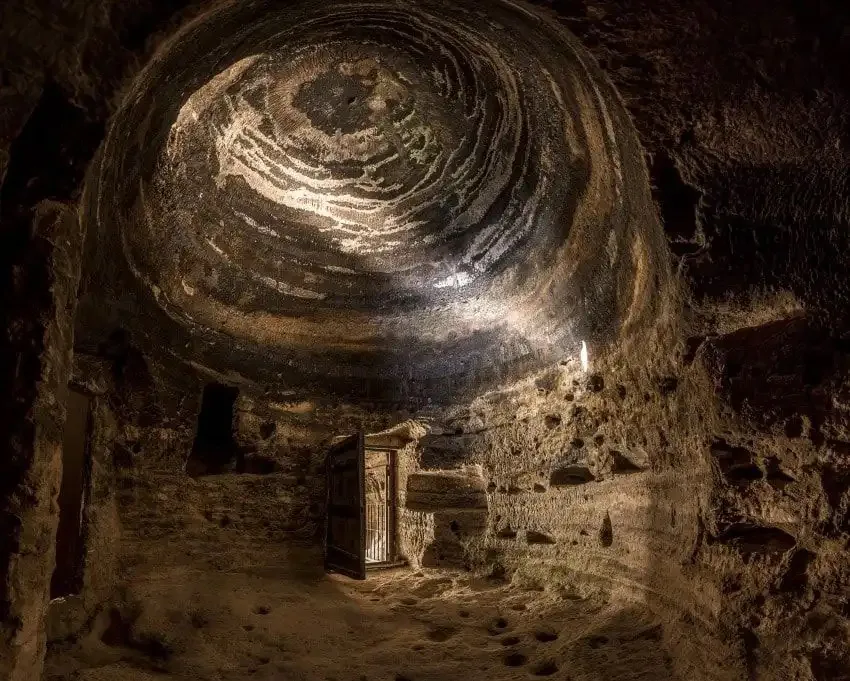
The Cuevas de los Canarios are cut into the crater wall and reached by a narrow single-file path from the floor: communal granaries and dwelling caves used by the island's pre-Hispanic inhabitants, with rupestrian carvings — marks cut into the rock face — among the most important on Gran Canaria. Occupation continued into the colonial period, which is unusual.
It is a protected site, not an attraction with a guide and a handrail: stay on the path and do not climb into the granary openings. For cave dwellings with a visitor centre built for them, go to the Guayadeque ravine.
The two viewpoints
Mirador Pico de Bandama (569 m)
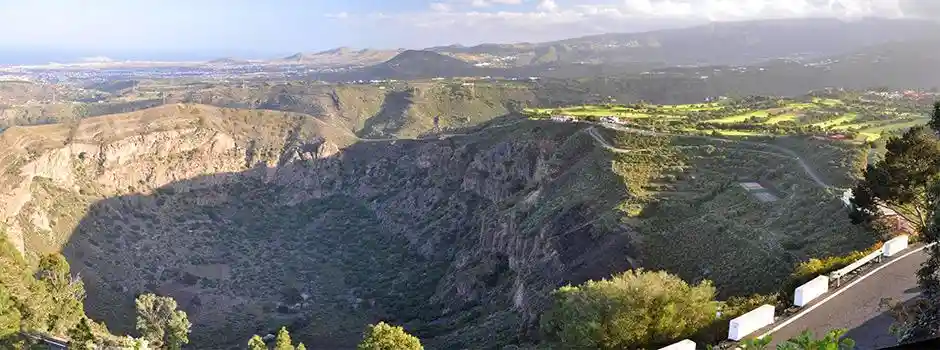
The one people mean. From the summit you get the whole crater below and a full turn of horizon: Las Palmas and its port north, the airport bay east, Tafira and Santa Brígida in the valley, and Fuerteventura when the air is clear. The wind is constant and stronger than it looks from the car park.
Mirador de Los Cuartos (380 m)
Lower and quieter, built from local volcanic stone, with panels on how the crater formed. It sits on the rim rather than above it, so you look across the bowl instead of down into it — the better stop for anyone who would rather not climb.
Wine and the bodega
Vines have been worked here since the early 1500s, and the ground below the rim is the heart of the Monte Lentiscal zone within the DO Gran Canaria denomination. The soil is picón — the volcanic gravel the eruption threw out — which traps night moisture and releases it slowly.
The bodega Hoyos de Bandama runs tours and tastings and bottles a white called Caldera. Ask at the counter which grapes are in it: the white varieties usually grown under this denomination are Listán Blanco and Malvasía Volcánica. Book ahead, especially at weekends and during the September harvest.
Take lunch in Santa Brígida rather than at the viewpoint; the Canarian food guide covers what to order.
Bodega at a glance
- Name: Hoyos de Bandama
- Denomination: DO Gran Canaria
- Zone: Monte Lentiscal
- Soil: Volcanic picón
- Visits: Tours and tastings, booking advised
History in the crater: the Guanches, Van Damme and the 1942 bunker
Before the conquest
The crater wall was in use long before anyone planted a vine in it. The granaries and dwellings of the Cuevas de los Canarios belong to a community that stored grain communally and lived in the rock — part of the record that runs through Risco Caído and Guayadeque.
Daniel Van Damme and Casas del Fondo
In the early 1500s a Flemish merchant, Daniel Van Damme, took on the crater floor and farmed it. His house down there, Casas del Fondo, was laid out in an L, with three threshing floors whose remains are still visible — and it is where the Monte Lentiscal wine area begins.
It has never been fully abandoned since. Agustinito, the crater's last full-time resident, still works plots on the same terraces. If you walk down you are crossing someone's farm: keep to the path and leave gates as you find them.
The 1942 bunker
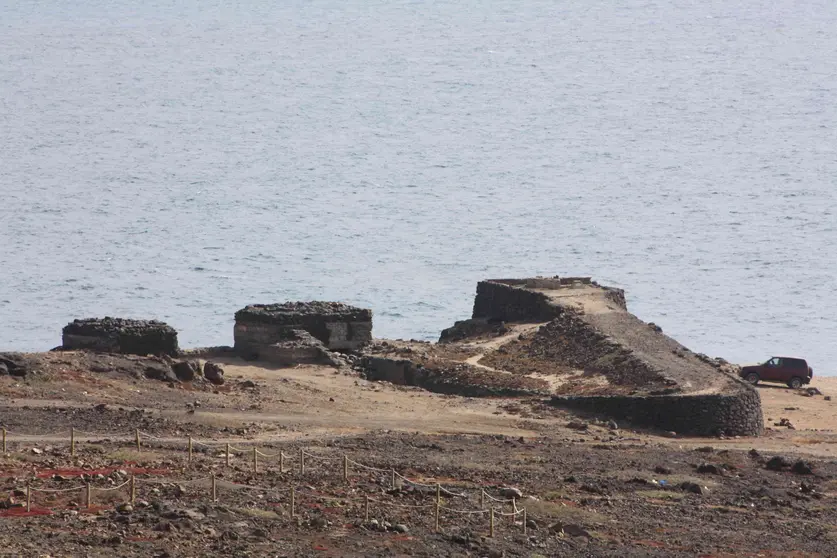
Under the visitor centre sits a military observation post built in 1942: about 15 square metres, reached through an L-shaped tunnel. The Canaries mattered to both sides in the Atlantic during the war, and this watched the approach to Las Palmas. An interpretation film about it is shown on request — ask at the visitor centre, as the arrangement changes.
Spain's oldest golf club
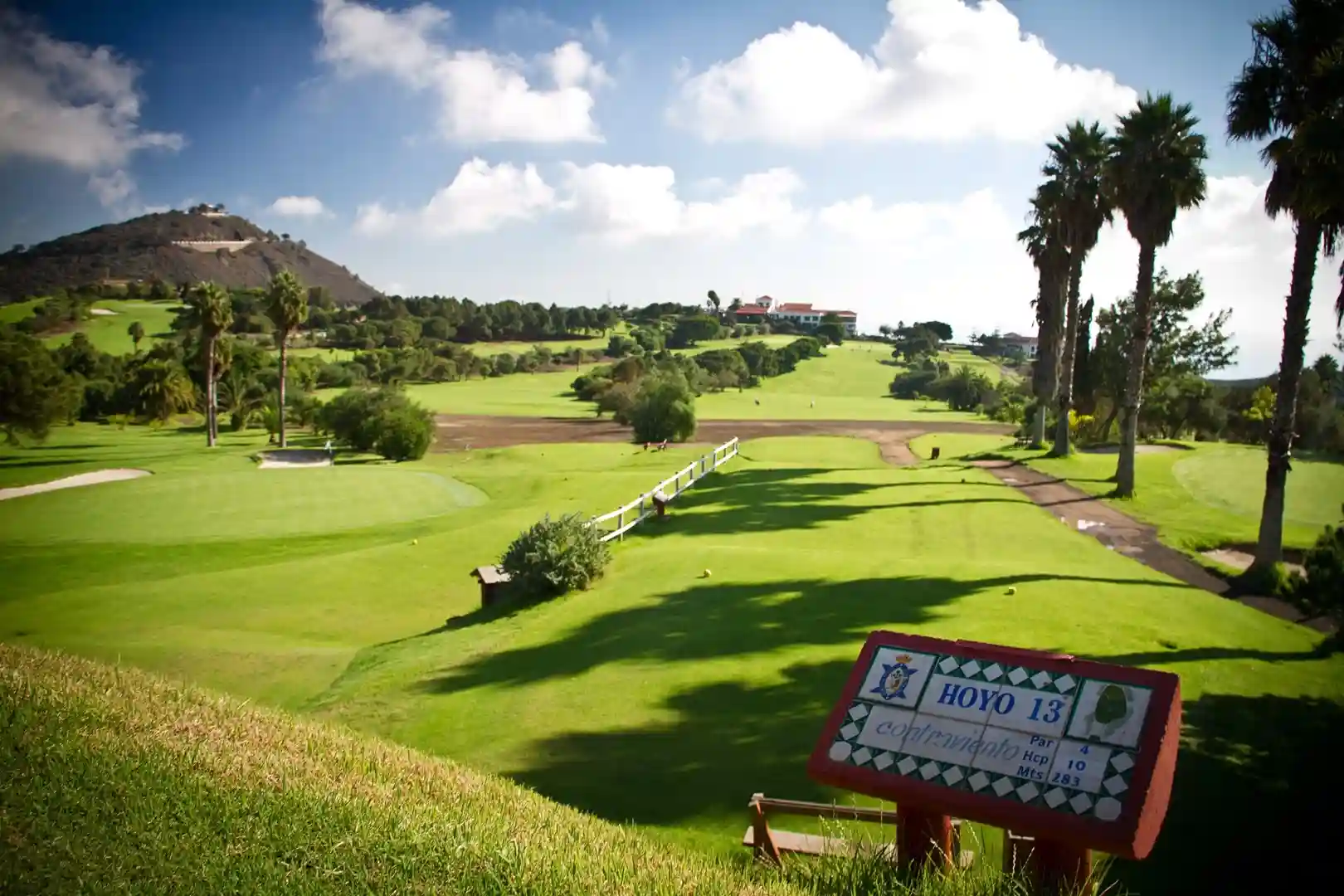
Real Club de Golf de Las Palmas, founded in 1891, is the oldest golf club in Spain, and its driving range sits on the rim — a ball hit badly enough drops 200 metres. It is private, but visible from the rim path.
Photography tips
- Work around the opening time. Mist collects in the bowl overnight and burns off in the first hour of light, but sunrise falls before the 08:00 opening in every month — arrive at opening for what is left of it. Sunset is the reliable slot: viewpoint access runs to about 22:00.
- Plan for wind, not light. The summit is exposed on every side and a light tripod will move.
- Wide from the Pico, standard from Los Cuartos. From the summit you need near 16–20 mm on full frame to fit the far rim in. From Los Cuartos a 35 mm frames it better: you shoot across the bowl rather than down into it.
- Telephoto for the flora. The endemic plants grow on the crumbling south-eastern cliffs. Shoot from the path — scrambling off-trail damages what you came for.
Planning your visit
Opening and cost
No ticket and free parking, but not round-the-clock access: generally 08:00–17:00, with the viewpoint access areas open until roughly 22:00. The visitor centre and the bodega keep their own hours — check before you go if you want the bunker film or the exhibits.
What to bring
- Shoes with grip — picón rolls underfoot
- Water; there is none on the routes
- A wind layer, even in August
- Sun protection: no shade on the rim
When to go
Arrive at opening for the calmest, clearest air, or come late for the warmest light — sunset falls inside the extended viewpoint access all year. Winter gives the best long-range visibility. Forecast: AEMET.
Accessibility
The summit car park to the viewing platform is short and surfaced, so the main view works with a pushchair or limited mobility. The rim circuit and the descent do not: unsurfaced, uneven and exposed.
With children
The viewpoints are fine and the panels at Los Cuartos hold attention. Think twice about the rim circuit, which runs near an unguarded drop, and the descent, a long hot climb.
Leave it as you found it
A Natural Monument with a protected archaeological site inside it and a working farm on the floor. Stay on the paths, take rubbish out, do not touch the carvings.
Making a day of it
Half a day at most, so pair it. Santa Brígida is ten minutes away, Vegueta and Santa Ana cathedral twenty back towards the coast, and inland the Guayadeque ravine is the natural second stop — the 7-day itinerary pairs them.
Frequently asked questions
Is Bandama actually a caldera?
No. It is a maar: a crater blasted open when rising magma met groundwater and flashed it to steam, not one left by a collapsing volcano. The island calls it a caldera anyway, and so do the signs.
Is Bandama Caldera free to visit?
Yes, no ticket and free parking; you only pay for a tasting at the bodega. It is not open around the clock, though: the viewpoint and natural area are generally open 08:00 to 17:00.
What are the opening hours at Bandama Caldera?
The Mirador Pico de Bandama and the natural area around it are generally open daily from 08:00 to 17:00, with the viewpoint access areas open until roughly 22:00. The visitor centre and the bodega keep their own hours.
Can you walk down into the Bandama crater?
Yes. A path drops from the Bandama village side of the rim to the floor, past the Casas del Fondo farmstead and the cultivated plots. Allow two to three hours return; the surface is loose picón and the climb back out is the hard part.
How long do you need at Bandama Caldera?
Thirty to forty-five minutes for the viewpoint, an hour and a quarter for the rim circuit, two to three hours if you walk down to the floor.
What is the cheapest way to get from Las Palmas to Bandama Caldera?
Global bus line 311 from San Telmo station: about €1.55 one way, against roughly €25 to €30 for a taxi.
Is there a direct bus between Las Palmas and Bandama Caldera?
Yes. Global line 311 runs direct from San Telmo station, Platform 4, towards Santa Brígida, stopping at Bandama beside the golf club.
How long does it take to get from Las Palmas to Bandama Caldera?
About 22 minutes on the 311 bus, and about 20 minutes by car.
How far is it from Las Palmas to Bandama Caldera?
Roughly 14 kilometres, or 8.7 miles, by road via the GC-802.
Can I drive to Bandama Caldera and is there parking?
Yes, on the GC-802 through Tafira. There is a free car park at the top of the viewpoint road and a second area by the visitor centre; both fill at weekends and around sunset.
Where can I stay near Bandama Caldera?
The Bandama Golf Hotel is about 0.8 km from the rim, the Hotel Rural El Mondalón about 1 km. Most visitors stay in Las Palmas and come out for half a day.

By Enrique Medina · Reviewed 31 August 2026
Local author from Las Palmas de Gran Canaria. This guide keeps to what can be checked on the ground. Fares and opening hours change — confirm before you travel.