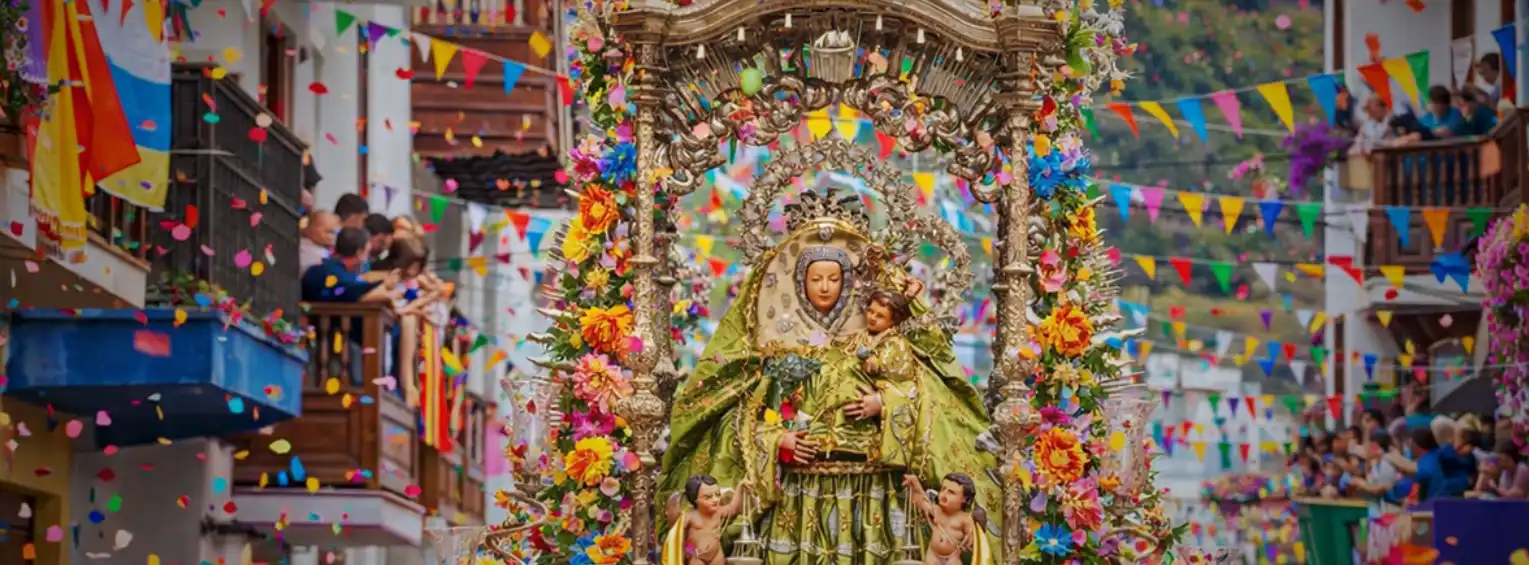
Romería del Pino in Teror: what a visitor needs to know
On the afternoon of 7 September, twenty-two decorated ox carts and folk groups from every municipality of Gran Canaria and all eight Canary Islands carry offerings through Teror to the Virgen del Pino. It is the biggest single day in the island's calendar — and the day the roads into town close.
What the Romería del Pino actually is
Teror is a small town in the green hills north of Gran Canaria, and its basilica holds the Virgen del Pino, patron of the island and of the Diocese of the Canaries. Tradition dates the origin to an apparition in a pine tree at Teror in 1481. Every September the town becomes the island's main place of pilgrimage.
The Romería-Ofrenda — literally the pilgrimage-offering — is the centrepiece. Twenty-two decorated ox carts process to the basilica loaded with food, followed by folk groups representing all 21 municipalities of Gran Canaria and all eight Canary Islands. The offerings are given to the Virgin at the church door, and the food is later distributed to charity.
The one thing to get right
The Romería is 7 September and the Día del Pino is 8 September. They are not the same event. The 7th is the loud one — carts, folk music, street parties, fireworks at midnight. The 8th is the formal one — the official reception, the solemn mass and the procession. Visitors who come for "the festival" on the 8th often find they missed what they pictured.
The main Fiesta del Pino festivities run from 30 August to 8 September. Around them the programme stretches wider still, from 28 August to 20 September, with the stalls open and more than 70 free concerts and shows. In 2026 the fiesta was declared a Fiesta de Interés Turístico Nacional, a national tourism distinction handed over by Spain's tourism minister in Teror on 22 June.
Getting there: roads, buses and parking
This is the part that catches visitors out. Teror is a 30-minute drive from Las Palmas on an ordinary day. On 7 and 8 September the road network around it is reversed, closed and filtered by permit. Take the bus.
By bus — the sane option
Global puts most of its fleet and staff onto Teror services on 7, 8 and 13 September and reinforces services around the main events. From the start of September it sells return tickets to Teror from Las Palmas in advance, which is worth doing. Lines 216 and 229 run from San Telmo station in Las Palmas direct to Teror; check the day's timetable before travelling, because the special services differ from the normal ones. Our island bus guide covers fares and how to pay.
By car — read this first
On 7, 8 and 13 September the town council runs a permit system for vehicles entering the old town: residents, deliveries, buses, the offering itself, officials and press. Without one of those you are not driving in. Parking in the centre is described by the council as very limited, with car parks under the Plaza de Sintes, at the Los Yánez Matos site, by and at the bus station, at Los Perales, by the petrol station at the entrance to town, and at the La Marina site in San Matías. If you must drive, see the car rental guide for what that involves.
On foot — the traditional way
Thousands walk through the night along the old royal paths, arriving in Teror at dawn on the 8th. The council's Vamos P'al Pino app maps 26 different walking routes from around the island. On 7 September a Pilgrim Point on the GC-21 at El Chaparral hands out materials to walkers from 09:00 to 13:00. Note that bicycles are banned on the GC-21 from 11:00 on the 7th until 15:00 on the 8th.
Road restrictions, 2026
From the official 2026 programme. Arrangements are set each year — check the current one before you travel.
Romería day, hour by hour
Monday 7 September 2026. Times are from the official programme.
What you are actually looking at
The carts are not floats. Each is built and decorated by a municipality or association and loaded with real produce — Teror's own cart for 2026 is titled Ellas, raíz de nuestra tierra and carries the town's chorizo and turrón alongside fruit and vegetables. Children from every municipality recite a décima, a ten-line verse, in praise of their home town.
Between the formal acts, small parrandas — impromptu bands with timple, guitar and voices — fill the streets. That is the part most visitors remember, and it is free, unticketed and everywhere.
The Día del Pino, 8 September
The island's feast day, and a public holiday in Gran Canaria. After the noise of the eve it is deliberately calm: institutional and religious, with the official reception, the military parade, the mass and the procession.
Eucharists on the hour in the basilica, then 14:00 and 17:30
Official reception of authorities on the Calle Real de la Plaza
Solemn Eucharist in the Basílica del Pino
Procession of Nuestra Señora del Pino through the old town
The basilica closes at 22:00 on the 8th. From the 8th to the 16th a solemn novena runs daily, and the image goes back up to its camarín on 20 September.
What to wear
You do not need traditional dress to watch, and nobody will mind ordinary clothes. But a lot of people do dress up, and the official programme is unusually direct about how to do it without getting it wrong.
If you dress traditionally
The programme suggests covering your head — a hat or a headscarf rather than nothing. An exhibition of 18th and 19th-century Canarian dress runs at the Teror tourism centre on the Plaza del Pino from 1 to 20 September, Monday to Saturday 09:30–16:30, if you want to see how it is properly done.
Traditional dress is compulsory only at the Verbena Canaria on 19 September, which closes the programme.
What the programme says to avoid
- Sleeveless T-shirts or shirts
- Trainers, or shoes with a stiletto heel
- Jeans, or very short trousers
- Skirts and aprons above the knee
- Modern handbags and contemporary accessories
Planning your day
Crowds
The fiesta draws 150,000 to 200,000 people to a town of a few thousand, and more than 400 police and civil protection officers work it, with drone surveillance over the old town and the footpaths. Expect to be shoulder to shoulder from mid-afternoon on the 7th.
Eating and drinking
The food and drink stalls, the chiringuitos, run on the Plaza de Sintes behind the basilica from 28 August to 20 September. Teror's own specialities are its chorizo, a soft spreadable sausage, and its turrón. Restaurants in the centre fill early and many work a reduced menu.
Where to stay
Teror has very little accommodation and the old town is sealed overnight on the 7th. Base yourself in Las Palmas and travel in and out — it is about half an hour each way by bus.
With children
The carts and animals are a genuine draw, and there are children's events earlier in the programme. But the crowd on Romería afternoon is dense and the music runs past midnight. Come early, watch the carts, and leave before the verbena.
Accessibility
Teror's old town is cobbled and sloping, and on the 7th it is both closed to vehicles and extremely full. If mobility is a concern, the 8th is far more manageable, or visit Teror on any ordinary day instead — the town guide covers that.
Respect the religious side
This is a working pilgrimage, not a folklore show put on for visitors. People walk through the night to keep a promise. Photograph freely in the street, but keep out of the way of the carts and the offering, and stay quiet inside the basilica.
Other dates worth knowing
5 September, the image is brought down from its camarín to the altar, where it stays for 15 days. 6 September, the folk gathering of the eight islands on the Plaza de Sintes. 13 September, the Día de las Marías, Teror's own patronal day, with its own procession and fireworks. 19 September, the Verbena Canaria in traditional dress. 20 September, the image goes back up. Full programme on the official festival site.
Frequently asked questions
What is the difference between the Romería del Pino and the Día del Pino?
They are two different days. The Romería-Ofrenda is the eve, 7 September: ox carts, folk groups, offerings and street parties, and it is the loud one. The Día del Pino is 8 September: the official reception, the solemn mass at noon and the procession at 13:00, and it is the calm, formal one. If you want the spectacle, come on the 7th.
When is the Romería del Pino in 2026?
Monday 7 September 2026. The first ox cart leaves the Castañero Gordo at 15:30 and the offerings begin at the basilica at 16:00. The main Fiesta del Pino festivities run from 30 August to 8 September, with the wider programme running from 28 August to 20 September.
How do I get to Teror for the Romería?
Take the bus. Global runs special reinforced services to Teror on 7, 8 and 13 September and sells return tickets from Las Palmas in advance from the start of September. Driving is a poor idea: the GC-21 becomes one-way towards Teror, closes entirely on the night of the 7th, and parking in the old town is very limited.
Which roads to Teror are closed for the Fiesta del Pino?
On 7 September the GC-21 from Tamaraceite is one-way towards Teror from 07:00 to 19:00, then closed from 19:00 until 02:00. The GC-219 is one-way 07:00 to 19:00 and closed from 19:00 to 02:00. The GC-43 towards Arucas is one-way from 07:00 on the 7th until 15:00 on the 8th, and the old town itself is closed from 19:00 on the 7th to 05:00 on the 8th.
Is the Romería del Pino free to attend?
Yes. The Romería, the religious services, the folk performances and the concerts on the Plaza de Sintes are all free and open to anyone. You only pay for food and drink.
What should I wear to the Romería del Pino?
You do not have to wear anything special to watch. If you do wear Canarian dress, the official programme asks you to avoid sleeveless tops, trainers and stiletto heels, jeans or very short trousers, skirts above the knee, and modern handbags or accessories, and it suggests a hat or headscarf rather than a bare head. Traditional dress is compulsory only at the Verbena Canaria on 19 September.
How crowded is the Romería del Pino?
The Fiesta del Pino draws between 150,000 and 200,000 people to a town of a few thousand, and more than 400 police and civil protection officers work the event. Expect dense crowds in the old town from the afternoon of the 7th onwards.
Can I walk to Teror like the pilgrims do?
Yes, and thousands do, arriving overnight on the old royal paths. The council's Vamos P'al Pino app maps 26 different walking routes to Teror from around the island. On 7 September a Pilgrim Point on the GC-21 at El Chaparral hands out materials to walkers from 09:00 to 13:00.
Can I see the Virgen del Pino during the festival?
Yes. The image is brought down from its camarín on 5 September and stays in the right side nave of the basilica until it is carried back up on 20 September. On the night of 7 to 8 September the basilica closes from 00:00 to 05:00, and during those hours the image stands in the atrium for pilgrims arriving through the night.
Where should I stay for the Fiesta del Pino?
Teror itself has very little accommodation and the town is sealed off overnight on the 7th. Most visitors base themselves in Las Palmas, half an hour away by bus, and travel in and out for the day.
Sources
Every date, time and road restriction on this page is taken from the official Fiesta del Pino 2026 programme published by the Ayuntamiento de Teror. Programmes are issued annually and details change — check the current one before you travel.

By Enrique Medina · Reviewed 31 August 2026
Local author from Las Palmas de Gran Canaria. This guide follows the 2026 official programme. Times and road arrangements are set each year — confirm them before you travel.